


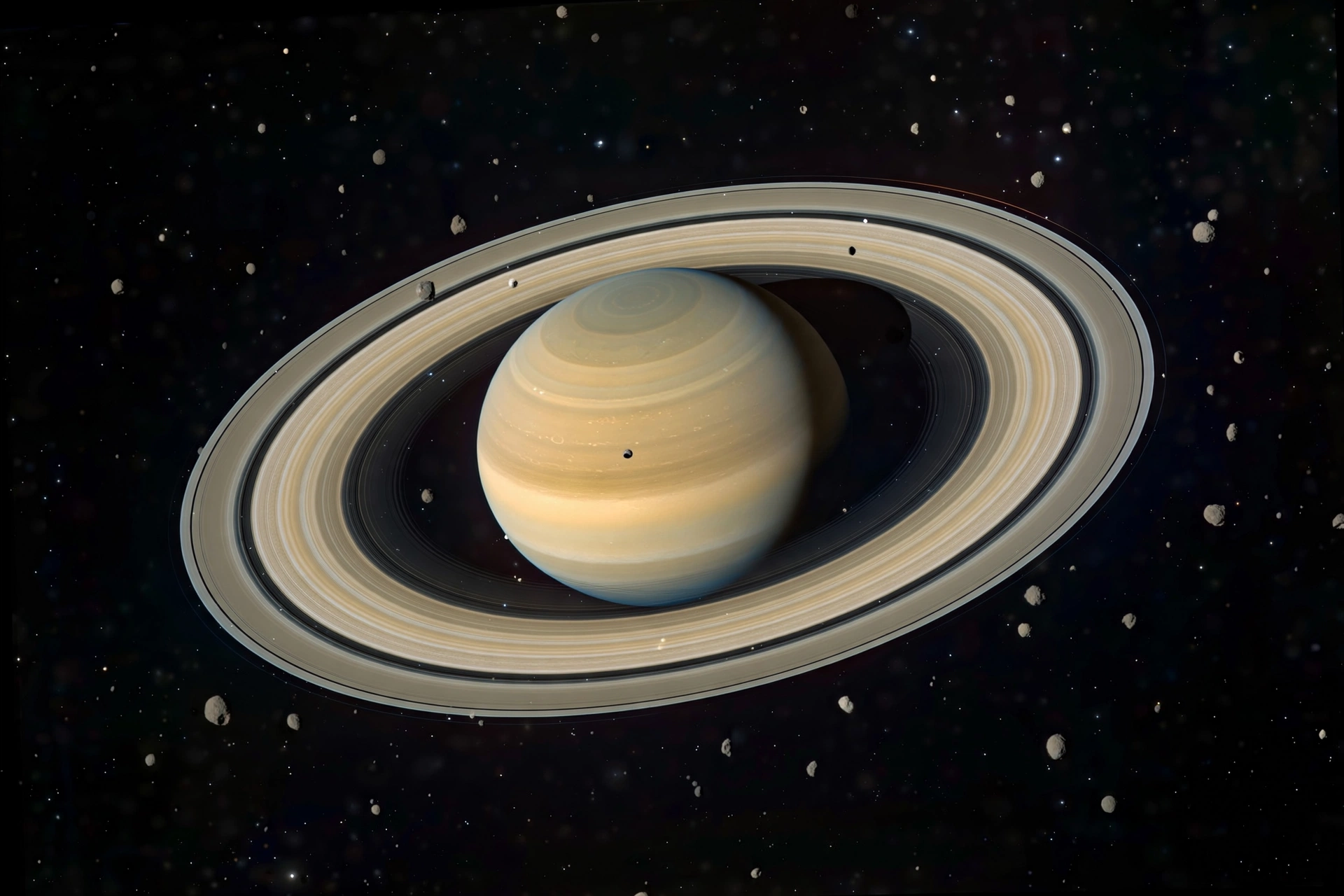
The solar system’s moon championship has a clear winner. Astronomers working with the Canada-France-Hawaii Telescope have confirmed 128 additional moons around Saturn, a haul that lifts the planet’s recognised total to 274. The new worlds, formally recognised by the International Astronomical Union, were not discovered in a single lucky night. They emerged from a methodical survey that revisited Saturn’s surroundings over multiple years, linking faint detections into dependable orbits with help from researchers at the University of British Columbia and partner institutions overseas.
The Shift-and-Stack Trick Behind the Finds
Finding a moon only a few kilometres wide, hundreds of millions of kilometres away, demands a clever technique. The team took long sequences of telescope images and shifted them at the rate Saturn’s moons appear to move, then stacked the frames together. Stars smear into trails under this treatment, but real moons add up into sharp points of light. That process, sometimes described as digital tracking, can reveal objects far too faint for any single photograph. Once candidates appeared, the astronomers scheduled further observations to pin down each orbit before submitting the evidence for formal recognition.
Saturn Pulls Away From Jupiter
For decades Jupiter was assumed to hold the moon record almost by default, simply because it is the largest planet. Better cameras and smarter software changed that assumption, and the lead has changed hands repeatedly since 2019. Jupiter’s tally now sits at 95 confirmed moons, which means Saturn’s 274 gives it nearly three times as many. Scientists involved in the survey say the gap is now so large that Saturn is unlikely to be caught, even though fresh Jupiter discoveries will certainly keep arriving as telescopes grow more sensitive to smaller and more distant objects.
Families of Fragments From Ancient Collisions
Nearly all of the new moons are irregular satellites, meaning they follow wide, tilted and often backwards orbits rather than neat circles in the planet’s equatorial plane. Many fall into families whose members share strikingly similar paths. The leading explanation is that each family began as a single larger moon, captured by Saturn long ago and later smashed apart by a collision. If that picture is right, the skies around Saturn were once a busier and more violent place. Technology readers may enjoy our recent analysis of how AI data centre spending is outrunning revenue, another story where patient number-crunching changed the headline.
Why Universities Share the Credit
Modern survey astronomy is a team sport. The University of British Columbia contributed researchers who helped confirm the new orbits, working alongside colleagues in Taiwan and at other observatories. Graduate students often perform the painstaking follow-up astrometry, measuring positions night after night so that a candidate detected in one season can be recovered in the next. Without that unglamorous labour, most faint candidates would simply be lost, because a moon seen once and never again cannot be confirmed, named in catalogues or studied further by anyone else.
A Census That Is Still Not Complete
Even after this announcement, astronomers suspect that smaller moons remain unfound, particularly those under a kilometre across or those hidden in Saturn’s glare during parts of its orbit. Planned facilities with larger mirrors and wider fields of view should extend the census further during the coming decade. Each addition refines models of how giant planets gather satellites and how collision debris evolves over cosmic time. The figure of 274 will probably not be the final word, but it marks the moment Saturn’s crown stopped being seriously contested, secured by persistence, computing power and an exceptionally patient team of sky watchers.
What This Means for Future Missions
A richer moon catalogue also has practical value for mission planners. Space agencies plotting future journeys to Saturn must navigate a system now known to contain hundreds of small bodies on crossing orbits, and accurate positions for them feed directly into trajectory safety calculations. The data likewise helps astronomers choose which moons deserve close-up study if a new orbiter is ever funded, since family representatives can reveal the composition of a parent body that no longer exists. In that sense, a survey conducted from a mountainside in Hawaii quietly shapes engineering decisions decades ahead, linking today’s faint detections to spacecraft that have not yet been designed, approved or built by anyone.
