



Opening a business bank account feels like a formality until the account starts getting in your way. A monthly fee that quietly triggers when your balance dips, a deposit limit that blocks a large client check, or an app that cannot export clean data to your accounting software can cost you hours every month. The right account, on the other hand, fades into the background and simply does its job.
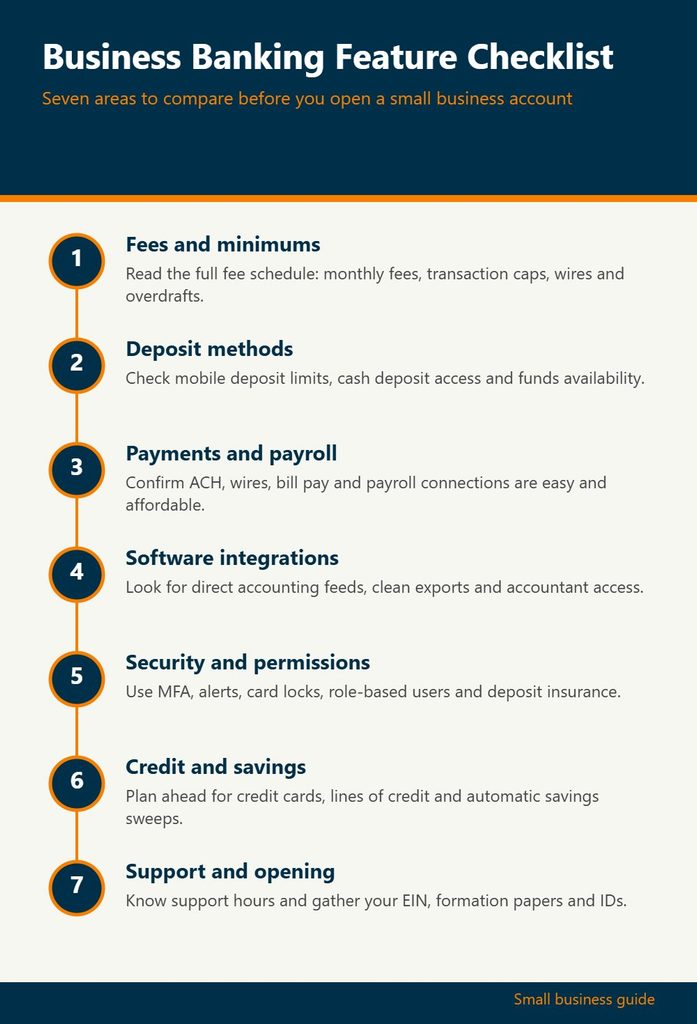
The problem is that bank marketing tends to highlight the same handful of perks while burying the details that matter for daily operations. A better approach is to walk into the decision with a checklist. The infographic below breaks business banking into seven feature areas, and the rest of this article explains what to look for in each one, which questions to ask, and where small businesses most often get caught off guard.
1. Fees and Minimum Balance Requirements
Start with cost, because it is the feature most likely to change your opinion of an account after six months. Many business checking accounts carry a monthly maintenance fee that is waived if you keep a minimum daily or average balance, hit a certain number of debit card transactions, or link another product such as a savings account or credit card. Those conditions sound easy until a slow month arrives.
When you compare accounts, look past the headline fee and read the full fee schedule. Pay special attention to:
- Transaction limits. Some accounts include a set number of free transactions per month and charge for each one after that. A business that writes many checks or makes frequent deposits can blow through the cap quickly.
- Cash deposit limits. Retailers, restaurants and service businesses that take cash often face a monthly cap on free cash deposits, with a per-dollar fee above it.
- Wire and transfer fees. Incoming and outgoing domestic wires, international wires and same-day transfers are frequently priced separately.
- Overdraft and returned item fees. Know what happens when a payment bounces and whether the bank offers overdraft protection linked to savings.
A practical exercise is to pull your last three months of activity, even from a personal account if you have been mixing funds, and estimate what each candidate account would have charged you. That number is far more useful than any advertised promotion.
2. Deposit Methods and Cash Handling
How money enters the account matters as much as how it leaves. A freelance designer paid entirely by bank transfer has very different needs from a food truck that ends every weekend with a bag of cash.
Mobile check deposit is now standard, but limits vary. Some banks cap the amount you can deposit per check or per day through the app, which can be a nuisance if a client pays a large invoice by check. If you handle cash regularly, confirm that the bank has branches or partner ATMs near you that accept cash deposits for business accounts. Online-only banks are often excellent on fees and software, but cash deposits can be awkward or limited, sometimes requiring a third-party retail location that charges its own fee.
Ask how quickly deposits become available. Funds availability policies differ, and a hold on a large check can create a short-term cash crunch if you need to make payroll the same week.
3. Payments, Transfers and Payroll Support
Your bank account is the hub for paying vendors, contractors and employees. Look at which outgoing payment methods are included and how easy they are to use. Common options include ACH transfers, wires, bill pay, physical checks and peer-to-peer payment integrations.
If you have or plan to have employees, check whether the account connects smoothly with the payroll provider you use or are considering. Some banks offer their own payroll services, while others simply work well with popular third-party platforms. Either way, you want direct deposit runs to fund reliably and on schedule.
Also consider receivables. Some business accounts let you send invoices or payment links directly from the banking app, and a few integrate with merchant services so card payments settle into the same account. That can simplify things for a very small business, though dedicated invoicing tools often offer more flexibility. GrowBizLab publishes practical guides on cash flow and getting paid faster, so if you want a deeper look at how payment timing affects your bank balance, click here to explore those resources.
4. Accounting and Software Integrations
For many owners, integration is the feature that separates a pleasant account from a painful one. If your bank feeds transactions cleanly into your accounting software, reconciliation takes minutes. If it does not, you end up downloading spreadsheets, fixing date formats and manually categorizing entries.
Before you commit, check:
- Whether the bank offers a direct feed to the accounting platform you use, rather than relying on a third-party aggregator that may disconnect periodically.
- How far back transaction history can be imported when you first connect.
- Whether you can export statements and transactions in common formats such as CSV, OFX or QBO.
- Whether receipts can be attached to transactions inside the banking app, which can save time at tax season.
It is also worth asking how the bank handles multiple users. If a bookkeeper or accountant needs read-only access, you should be able to grant it without sharing your own login credentials.
5. Security, User Permissions and Fraud Protection
Business accounts are attractive targets for fraud, and the protections differ from what you may be used to on a personal account. Consumer protections on personal accounts do not always apply in the same way to business accounts, so it is important to understand your responsibilities and the bank’s tools.
Look for multi-factor authentication, real-time alerts for transactions above a threshold, and the ability to lock or freeze a card instantly from the app. Larger banks often offer positive pay services, which compare checks presented for payment against a list you provide, and ACH blocks or filters that stop unauthorized debits. Smaller businesses may not need every advanced tool, but they should know which ones exist.
User permissions deserve their own attention. As soon as someone other than you touches the account, you will want controls such as:
- Separate logins for each person.
- Role-based access, for example view-only for a bookkeeper.
- Approval workflows where one person initiates a payment and another approves it.
- Individual employee debit cards with spending limits.
Finally, confirm that deposits are protected by federal deposit insurance through the FDIC, or through the NCUA if you choose a credit union. Some financial technology companies are not banks themselves and hold deposits through partner banks, so read the fine print to understand how insurance applies.
6. Credit, Savings and Growth Products
Your first account does not need to come with a full menu of lending products, but it helps to think ahead. A banking relationship can make it easier to qualify for a business credit card, line of credit or term loan later. Some lenders weigh the history of your deposit account when evaluating applications.
Questions to ask at this stage include whether the bank offers business savings or money market accounts with reasonable yields, whether you can sweep excess cash into savings automatically, and whether the bank participates in SBA-backed lending programs. If building business credit is part of your plan, a business credit card that reports to commercial credit bureaus can help establish a track record separate from your personal credit.
You do not have to put every product at the same institution. Many owners keep checking at one bank for convenience and use another lender for credit. Still, having growth options available at your primary bank can simplify life later. If you are weighing how credit and banking fit together, GrowBizLab covers business credit and funding topics in plain language, and you can read more there before you sit down with a banker.
7. Customer Support and Account Opening Requirements
The last item on the checklist is the one people think about only when something goes wrong. If a payment is stuck, your card is declined while traveling or you suspect fraud, how quickly can you reach a knowledgeable person? Look at support hours, channels such as phone, chat and in-branch help, and whether business customers get a dedicated line.
Account opening requirements also vary. Expect to provide some combination of the following, depending on your business structure and the bank:
- An Employer Identification Number, or your Social Security number for some sole proprietors.
- Formation documents such as articles of organization or incorporation.
- An operating agreement or corporate resolution showing who can sign.
- A business license or assumed name certificate if you operate under a trade name.
- Personal identification for each owner above a certain ownership threshold.
Gathering these documents before you apply prevents back-and-forth and can get your account open in a single visit or online session.
Putting the Checklist to Work
Once you understand the seven areas, the comparison becomes manageable. Narrow your options to three candidates: often one national bank, one local bank or credit union, and one online-focused option. Then score each against the features that matter most for your business model. A consulting firm might weight integrations and transfer fees heavily, while a retail shop will care most about cash deposits and branch access.
A few common mistakes to avoid:
- Choosing based on a sign-up bonus. Bonuses are nice, but they disappear after the first year while fees and limitations remain.
- Ignoring growth. An account that suits a solo freelancer may become frustrating once you hire two employees and need permissions and payroll.
- Mixing personal and business funds. Keeping a dedicated business account supports cleaner bookkeeping, simpler tax preparation and, for LLCs and corporations, helps maintain the separation between you and the business.
- Never revisiting the decision. Banks change fee schedules and features. A quick annual review keeps you from overpaying.
Switching banks later is possible but tedious, since you have to update payment details with clients, vendors, payroll and subscriptions. Spending an extra hour now on careful comparison is almost always cheaper than moving everything in a year.
Business banking is not glamorous, but it is foundational. Treat the checklist as a living document: print it, mark which features you truly need today and which you expect to need within two years, and use it every time you talk to a bank. The account that scores best on your priorities, not the one with the flashiest advertising, is the one that will serve your business well.
